

Article
Culture Isn’t a Perk. It’s a Psychological Contract.
Culture isn't what you say matters. It's what people experience consistently enough to believe.
· Updated
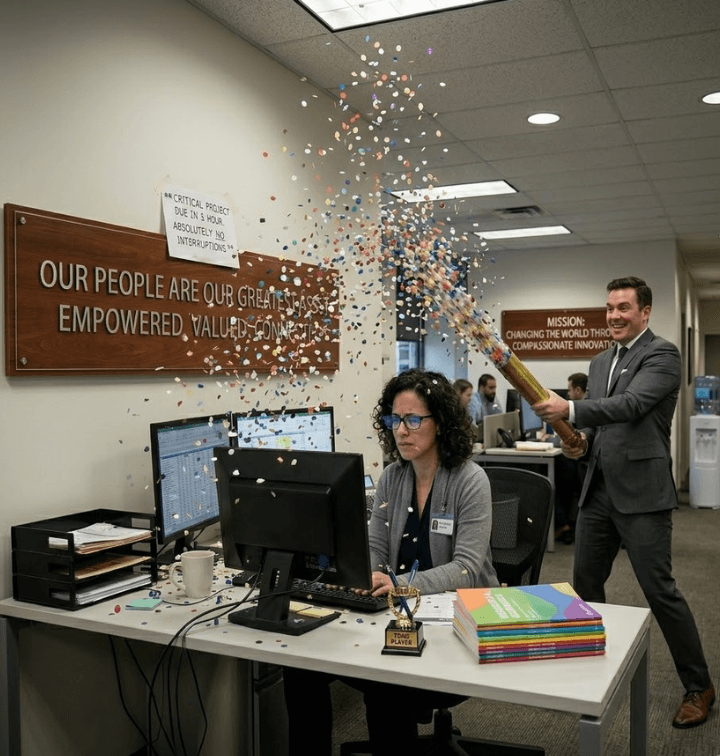
Most organizations say they want a “purpose-driven culture.”
What they often build instead is a branding campaign.
Mission statements get printed on walls. Values show up in onboarding decks. Leaders talk about impact in town halls. Yet employees still disengage, burn out, or quietly disconnect from the organization’s deeper goals.
Why?
Because people don’t commit to purpose simply because it’s communicated. They commit when it aligns with how they are naturally wired to work, contribute, and trust.
That’s the gap many organizations miss.
Culture is not what leaders say matters. Culture is what people experience repeatedly enough to believe. And when purpose becomes disconnected from human motivation, even the best intentions start to feel performative.
The organizations that last understand something different: sustainable culture is built at the intersection of psychology, behavior, and meaning.
Why “Purpose” Often Fails Inside Organizations
Many leaders assume culture problems are communication problems.
“If employees understood the mission better, they’d be more engaged.”
But behavioral science tells us something more important: humans are motivated less by abstract ideals and more by whether their environment consistently reinforces their innate drives.
That distinction matters.
A highly collaborative employee may feel deeply connected to a culture centered around belonging and team cohesion. Another employee may feel most fulfilled when given autonomy, ownership, and the freedom to solve difficult problems independently.
Both can care about the same organizational mission.
But they experience purpose differently.
This is where many cultures quietly fracture.
Organizations unintentionally create environments that reward only one style of contribution. Over time, people who naturally think, communicate, or execute differently begin to feel misaligned — even when they believe in the mission itself.
The result is predictable:
- Engagement declines
- Trust erodes
- Innovation slows
- Turnover rises
- Culture becomes compliance instead of commitment
Research in organizational psychology consistently shows that employees sustain motivation when three psychological conditions exist:
- They understand how they contribute
- Their work aligns with intrinsic drivers
- They feel psychologically safe expressing those drivers
Without those conditions, purpose becomes aspirational language disconnected from daily experience.
The Hidden Psychology Behind Meaningful Cultures
Purpose-driven organizations are not built by hiring people who “fit the culture.”
They are built by understanding the diverse motivational systems already inside the organization.
At Aptive Index, this starts with understanding innate drives rather than personality labels. The assessment measures core motivational attributes like:
- Influence — the need to shape direction and outcomes
- Sociability — the need for connection and belonging
- Consistency — the need for stability and predictability
- Precision — the need for accuracy and standards
These aren’t soft preferences. They shape how individuals experience trust, contribution, recognition, and fulfillment.
For example:
A highly visionary “Eagle” archetype may feel purposeful when building something new, influencing strategy, and driving innovation.
Meanwhile, a structural “Wolf” archetype may experience meaning through creating systems, reliability, and operational excellence that keep the organization functioning smoothly.
Neither contribution is more valuable. But cultures often celebrate one while unintentionally overlooking the other.
That imbalance creates disengagement that leaders frequently misinterpret as performance issues.
In reality, it’s often motivational misalignment.
What Doesn’t Work
Generic Values Statements
Words like integrity, innovation, and collaboration sound meaningful but often fail behaviorally because they’re too abstract.
Different people interpret them differently.
For one employee, “collaboration” means constant brainstorming and open discussion. For another, it means clear communication with minimal interruption.
Without understanding the motivational lens employees bring to those words, organizations create confusion instead of alignment.
Hiring for “Culture Fit”
This is one of the most expensive mistakes organizations make.
When leaders hire for comfort and similarity, they often over-index on one behavioral style. Teams become culturally homogeneous, which feels harmonious initially but weakens adaptability, challenge, and innovation over time.
Strong cultures are not built on sameness.
They are built on complementary strengths.
Purpose Without Systems
Purpose cannot survive in systems that reward contradictory behavior.
An organization cannot preach employee wellbeing while rewarding constant urgency. It cannot claim innovation matters while punishing calculated risk-taking.
Employees trust systems more than slogans.
And trust is fundamentally psychological. According to the Aptive Index Trust Framework, individuals evaluate trust through three dimensions:
- Character — Will they do what they say?
- Competence — Can they deliver?
- Compassion — Do they care about my wellbeing?
Culture erodes when those expectations consistently go unmet.
The Alternative: Designing Culture Around Human Hardwiring
Purpose-driven organizations that last tend to do three things exceptionally well.
1. They Normalize Different Motivational Styles
The healthiest cultures recognize that not everyone contributes the same way.
Some employees energize teams socially. Others stabilize operations. Others challenge assumptions. Others create technical mastery.
High-performing organizations intentionally create space for all of those contributions rather than unconsciously rewarding only the loudest or most visible styles.
This reduces unnecessary friction and helps employees feel psychologically understood.
2. They Build Teams With Complementary Strengths
Behavioral diversity matters strategically.
A team filled entirely with visionary thinkers may generate endless ideas but struggle with execution. A team composed entirely of highly structured operators may execute flawlessly but resist innovation.
The strongest organizations intentionally balance:
- Vision & Possibility
- Strategy & Challenge
- Drive & Delivery
- Systems & Stability
- Knowledge & Mastery
- Connectivity & Energy
Purpose becomes sustainable when organizations value all six forms of contribution.
3. They Make Self-Awareness Operational
Most organizations treat self-awareness as personal development.
The best organizations treat it as infrastructure.
At Aptive Index, this aligns with the Phoenix Framework:
- Data — Understanding behaviors
- Impact — Recognizing effects on others
- Drives — Understanding underlying motivations
The deeper leaders understand the “why” beneath behavior, the more effectively they can build trust, communication, and alignment across teams.
That creates cultures that feel authentic instead of performative.
What This Looks Like in Practice
Consider a fast-growing technology company struggling with burnout and rising turnover.
Leadership believed the issue was workload. But deeper analysis revealed something else: the company’s culture rewarded only high-urgency, high-influence behavior.
Employees who thrived on thoughtful analysis, precision, or structured execution felt chronically undervalued — despite being critical to long-term scalability.
Once leadership understood the motivational imbalance, they made several shifts:
- Meetings became more inclusive of reflective contributors
- Decision timelines allowed space for strategic analysis
- Recognition systems expanded beyond visible leadership behaviors
- Teams were intentionally balanced across working styles
Within months, collaboration improved, trust increased, and retention stabilized.
Nothing about the mission changed.
But employees finally experienced the culture in a way that aligned with how they were naturally wired to contribute.
That’s the difference between performative purpose and sustainable purpose.
Building a Culture That Actually Lasts
Leaders don’t create meaningful cultures through inspiration alone.
They create them by designing environments where different people can contribute meaningfully without abandoning how they naturally operate best.
That requires moving beyond personality stereotypes and surface-level engagement tactics.
It requires understanding the psychological architecture beneath behavior itself.
The organizations that thrive over the next decade will not simply have better missions.
They will have better alignment between:
- purpose,
- people,
- trust,
- and human motivation.
Because culture isn’t built by what’s written on the wall.
It’s built by what people consistently experience every day.