

Article
Your Best Player Probably Shouldn't Be Your Captain
Before you name a captain, ask: Who does the group orient around when things get hard? That's where real leadership actually lives.
· Updated
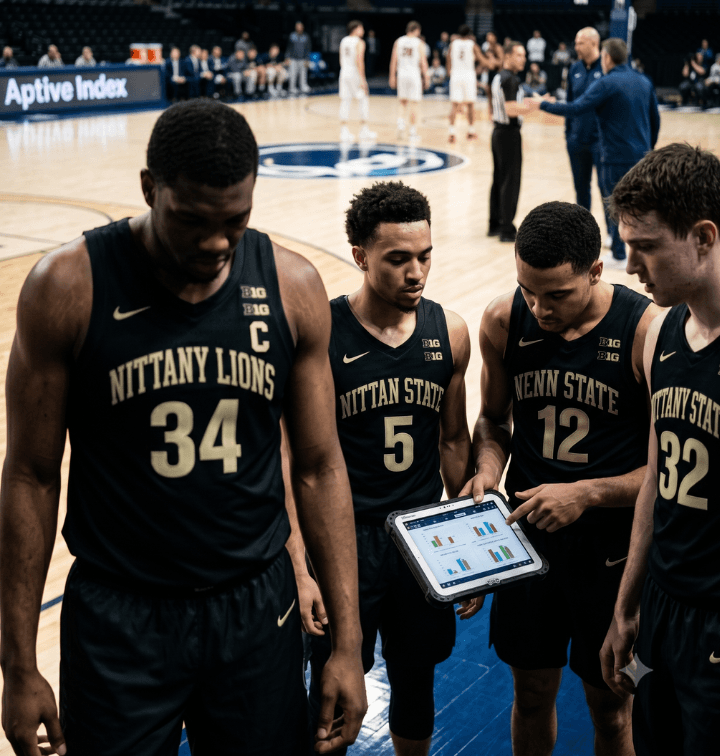
Picture the scene: a packed film room, a roster full of talent, and a coaching staff trying to figure out where to put the "C." Almost always, the answer comes back to the same player. The one who fills the silence. The one whose voice carries.
It's an understandable instinct. It's also frequently wrong.
Aptive Index recently completed behavioral mapping on a back-to-back conference champion basketball program — 31 wins, 5 losses, the best sustained record in its conference's history. What the data showed was quietly counterintuitive. The team's two best players didn't fit the traditional leadership mold. The point guard's profile read as a low-assertiveness connector, not a floor general who commands the huddle. The highest-energy starter, the one most coaches would hand the room to, happened to be the weakest shooter on the roster. The head coach's own emotional-processing score sat at the very bottom of the scale.
On paper: a leadership deficit. On the court: one of the most precisely aligned teams in the sport that season.
Leadership Doesn't Always Announce Itself
There's an old distinction in leadership research between authority you're given and influence you earn. Most leaders already sense this. What behavioral data adds is visibility into how that earned influence actually moves through a group.
When Aptive mapped this roster across core behavioral dimensions, the data didn't show an absence of leadership. It showed leadership running through a channel most coaches aren't trained to look for.
The team's most productive players were structured, consistent, and allergic to noise. They didn't campaign for the room. They demonstrated a standard — possession after possession — until the rest of the roster started orienting around them without being told to. We call this gravitational leadership: influence that accumulates through visible reliability, not declared authority.
The point guard's profile followed the same pattern. Rather than a ball-dominant player imposing a personal style, the data described a "reads the room" archetype — someone whose value comes from sensing what the defense is willing to give up and delivering the ball there. That's not a compromise at the position. It's the job description, once you understand what the job actually requires.
Even the team's weakest shooter carried the highest prosocial-drive score on the roster — a measurable pull toward group outcomes over individual ones. His contribution never showed up in the box score. It showed up in whether the team held together when the score wasn't going their way.
Where Most Programs Get It Wrong
The instinct most teams follow is simple: find the most assertive, highest-usage player, and hand them the room. It's an easy shortcut, because assertiveness is visible — and visibility gets mistaken for capability.
But push a high-precision, low-assertiveness player into a loud, "alpha" leadership style, and you don't create a leader. You create friction. You burn energy the player would rather spend executing.
The same mistake happens constantly off the field. Leaders who assume influence has to be loud consistently walk past the person who's already quietly setting the standard everyone else is following.
Finding the Leadership That's Already There
The fix isn't recruiting louder leaders. It's identifying where influence is already flowing and building structure around it on purpose. That means asking different questions: Who does the group orient around when things get hard? Whose consistency is the floor everyone else stands on? Where is emotional and cultural connectivity actually concentrated — and is it resilient, or is it running through one or two people?
In this program's case, the data flagged exactly that last risk. Cultural connectivity was carried by a small handful of players. That's not a problem you solve by adding more "energy guys." It's a structural dependency worth protecting deliberately — the same way a team protects its starting rotation.
The Same Pattern, Under Different Pressure
The same behavioral lens applied to a struggling program told a related story. Aptive's work with a Division I baseball team sitting at 1-11 found that its most vocal, vision-driven players — the ones normally counted on to rally a losing locker room — were instead experiencing narrative collapse: privately blaming teammates, quietly checking out of the group's story.
Left alone, that group's instinct to "lead louder" would have accelerated the fracture. What worked was giving those players a new, credible mission instead of asking them to project confidence they didn't feel — while protecting the quieter, process-oriented players who were actually holding the team's standards together.
Two very different programs. One winning big, one losing badly. Same lesson: leadership isn't where you assume it is. It's where the data shows influence is actually flowing.
What to Do This Week
Stop equating volume with value. Before you assign a captain, a title, or a lead role, map who the group actually orients around under pressure — not who talks the most in meetings.
Protect your gravitational leaders. High-precision, quietly consistent performers don't need more spotlight. They need cover from being forced into a communication style that isn't theirs.
Find your connectivity risk. Identify how many people are actually carrying your culture. If the answer is one or two, build redundancy before you need it.
Match leadership style to the role, not the stereotype. A "reads the room" profile at the center of your operation isn't a workaround. Confirm it's the right fit for what the role actually requires.
Audit your own wiring. The behavioral climate a leader creates sets the ceiling for what the rest of the team can become. Know what your leadership style makes possible — and what it costs the people around you.
The teams and organizations that win consistently aren't the ones with the most obvious leaders. They're the ones who've correctly identified where leadership already lives — and built a system to protect it.
Aptive Index applies behavioral science to athletic and organizational performance, translating psychometric data into deployment, coaching, and leadership decisions that hold up under pressure.